All posts by Admin

Should I Lodge Tax Return By Myself?

Lodging tax return? … It is the tax season again. Your mind is wondering how you should lodge your tax return this year. So you’re asking yourself if you’re going to lodge tax return by yourself or going to a registered tax agent for lodging your tax return. The simple answer to this is it depends on your situation. Because everybody is unique and your tax situation is no different.

Basically, the following situation will give you some guidance whether DIY or using a tax agent for lodging your return:

Are you in business or wage earner?

If you’re in business, most likely you would engage a registered tax agent/accountant to help you lodge your tax return. The tax law surrounding the business situation is complex and it changes rapidly. Hence, it requires a deeper knowledge and understanding of taxation issues. Don’t rely on the advice you have from a friend or a bit of research you have on the internet information. They will certainly not take any responsibility if something goes wrong.

You probably could lodge tax return by yourself if it is only a simple wage earner without many claimable deductions. Furthermore, you are confident enough about your knowledge surrounding simple personal tax returns.  The easiest way to do this is through MyGov. It is free and the only online channel the Tax Office approved for lodging your personal tax return.

USING A REGISTERED TAX AGENT TO LODGE TAX RETURN?

Australian Taxation Office (ATO) has issued a warning that they have identified some registered and unregistered tax agents lodging tax returns through the MyGov channel. Therefore, it is a breach of ATO Online terms for registered tax agents to use MyGov for lodgement.

To check if you engage with a registered tax agent, please see Tax Practitioners Board – TPB’s website. There are many dodgy preparers out there. So for your safety, you should only deal with a registered tax agent listed on TPB’s website.

On top of that, many accountants belong to a professional body
(i.e.: CPA Australia, ICAA, IPA, NTAA, etc.) and offer their service directly to the public. These are public accountants. The professional body is the governing body for them. The professional body will grant the public licence to its members only after fulfilling stringent requirements from the professional body. So only accountants with public practice licence can offer their services to the public. Therefore having a tax agent with this background will give you a minimum standard service expectation from the professional body.

What situations you had during the financial year?

The next question is to see what sort of transactions or deductions you probably had during the past financial year. If so, do you have the following situation?

WORK-RELATED EXPENSES (WRE) CLAIMS.

ATO provides clear guidance for claiming the deductions when you lodge tax return:

  • you must have spent the money yourself and weren’t reimbursed
  • it must directly relate to earning your income
  • You must have a record to prove it.

For further information about types of deductions you can claim can be found on ATO’s website.

Caution on this: as the ATO’s data matching program is getting sophisticated, you should be able to substantiate your claims in your tax return. The inquiry may come from specific occupations target for this year, benchmark data matching, data matching program or random audit.

ADDITIONAL SITUATION

Another situation that may happen to you in this financial year is if you have:

  • any capital gain event,
  • rental property income,
  • profit distribution,
  • estate assets disposal,
  • unusual tax situations, or
  • perhaps just want more clarification/certainty.

This may need deeper tax knowledge than the standard tax return lodgement that you can handle. Therefore in this situation, it is better to use a registered tax agent on your behalf.

ADVANTAGES OF USING A TAX AGENT TO LODGE TAX RETURN

There are several benefits using a qualified tax agent to prepare your tax return:

  • You can claim the cost you incurred for engaging a registered tax agent. When a registered agent lodges tax return on your behalf, the fee is certainly claimable the following year.
  • A good registered tax agent will guide you through his/her checklist ensuring all deductions that you entitle to are claimable. You also need to demonstrate that you can substantiate your claims if there is an inquiry from ATO. For example: maintaining receipts, logbook, diary, or other supporting documents. Therefore you need to keep your record for this purpose.
  • Sometimes when you come to visit your accountant/tax agent, it happens after 30 June. So, there is very little that your accountant can do to improve your tax condition for the past year. A good registered tax agent would generally highlight the areas you need to focus on for the following year. So your next year situation will be in better shape. Always ask your accountant/tax agent what you probably need to do/prepare to improve your situation for the coming year.
  • It helps you free your valuable time and stress. To some people tax return preparation is very time consuming and stressful. Not to mention that you may forget some of your claims unless your accountant/tax agent highlights them. Therefore asking a registered tax agent for this is a better option.
  • A good registered tax agent has to maintain a minimum qualification and continuous professional development. Tax agents/accountants spend enormous time and resources on this. This is one part of the compliance requirements from the government regulatory bodies and their professional bodies. Consequently, this will improve your comfort and peace of mind of their knowledge and expertise.
  • A good registered tax agent would make sure that your claims stay within the legal boundaries when preparing your return. In contrast, you do not want ATO knocking on your door to inquire about your past lodgement. ATO may impose a penalty and interest for misleading lodgement.
  • A good registered tax agent/accountant will be a good companion. You may need the advice from your tax agent/accountant in the future as your situation changes. For example, you may have an intention to start/buy a business, buying/selling property, accountant’s letter for your home loan, etc. So maintaining a good relationship with your accountant is important.
  • Instant extension time for lodging your return. Engaging with a registered tax agent will give you an instant extension time. However, it is subject to no outstanding returns from previous year. Your tax agent would also need to add you to their portal before 31 October. The standard tax return lodgement due date is 31 October. Once your agent has uploaded your details, your lodgement time will follow the tax agent’s lodgement time. It is usually by 15 May the following year.

Finally, after reviewing the above topics you can decide how to progress from here. Considering how complex your situation rather than the cost alone. In contrast, you also should consider carefully your own knowledge/skills you have. If you decide to use a tax agent service, please make sure you use a registered tax agent for this.

As mentioned before, the tax agent fee is fully deductible for the following year. However, if you engage with an unregistered tax agent not only the fee is not deductible, you’re also putting yourself at risk for wrong information from the unregistered provider.

Should you require any help to lodge your tax return, please do not hesitate to contact us. We are a CPA firm located in South Eastern suburb of Melbourne.

FREE Accounting Software – WAVE

A client introduced me to an accounting software. It is not a trial software. It is fully functional accounting software to run your business. And the other good thing is it is free and cloud base. This means you can access it from anywhere. This accounting software is WAVE,

<a href="https://waveapps.com/?source=WPNbadge"><img src="https://waveapps.com/sitestatic/public/img/pro-network-badge.png" alt="Free online accounting software for small businesses -- Wave" /></a>

Let us know if you need any assistance to help you set up your WAVE to tailor to your business.

‘On the spot Fine’ is on The Way

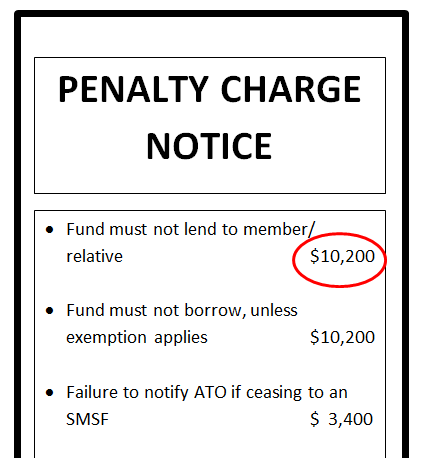
Penalty NoticeAs you may aware the parliament has passed the new penalty regime for Self-managed Superannuation Fund (SMSF). Under the new legislation, ATO will gain the power to issue on the spot fines, directly and personally, to SMSF trustees using a range of penalties to match the seriousness if an offence.

The new regime also increases the penalty unit from $110 to $170, or increased by 55%. ATO has indicated that each reported offence will automatically generate a penalty notice on each trustee.

This will put individual trustees to a disadvantage situation compare to a corporate trustee, as each trustee will bear the fines individually.

For example, a contravention report is reported to ATO due to lending money to a member or a relative (a serious breach of section 65(1)). This will attract a fine of 60 penalty points, or $10,200 (60 x $170).

If the trustee is a corporate trustee, then only the company will get the fine of $10,200. On the other hand, if the fund is individual trustees with 3 members, then each member may get a fine of $10,200, or a total fine of $30,600.

Trustee(s) may apply to waive the fines. ATO may waive or reduce the penalty based on past history and seriousness of breach. ATO also may order the trustee(s) to:

• Rectification direction (sec. 159) – a written order by ATO to trustees to correct their wrong-doing within specified time period. For example, ATO may direct trustees to sell their property (if they were not prepared to this voluntarily).

• Education direction (sec. 160) – a written order to trustees to attend a specified course of education within a specified time period.

Below is some penalty guidance that may be imposed by ATO:

Section Description Penalty Units Penalty of each trustee
160(4) Failure to comply with Tax Office education direction 5 $850.00
124(1) Failure to appoint an investment manager in writing when one is appointed 5 $850.00
254(1) Failure to provide information to regulator on approved form 5 $850.00
347A(5) Failure to complete a form with requested information as part of ATO’s survey 5 $850.00
35B Failure to prepare financial statements 10 $1,700.00
103(1) & (2) Failure to keep trustee minutes for at least 10 years 10 $1,700.00
104 (1) Failure to keep records of change of trustees for at least 10 years 10 $1,700.00
34 (1) Failure to follow prescribed standards 20 $3,400.00
106A(1) Written notice to ATO if ceasing to be an SMSF 20 $3,400.00
65(1) Fund must not lend to member/relative 60 $10,200.00
67(1) Fund must not borrow, unless exemption applies 60 $10,200.00
84(1) Fund must not breach in-house asset rules 60 $10,200.00
106(1) Failure to notify ATO of significant adverse events immediately 60 $10,200.00

Managing Your SMSF

One of trustee key responsibilities is managing your fund’s investments. The investment decisions should be designed to protect and increase members’ benefits for retirement. Let’s take a look on things that required in managing your SMSF:

Investment strategy

Every SMSF has to have a written investment strategy. This sets out your fund’s investment objectives and how you plan to achieve them. It takes into account the personal circumstances of all the fund members, including their age and risk tolerance. Your investment strategy will help you maintain the right mix of investments for your fund and its members.

Restrictions on investments

Being a trustee of an SMSF gives you the flexibility to choose the investments for your fund, but there are some restrictions on how you invest and what you can invest in. Make your investments on a commercial, ‘arm’s length’ basis and don’t buy assets from, or lend money to, fund members (or other related parties). Generally, your fund can’t borrow money.

Ownership and protection of assets

You need to manage your fund’s investments separately from the personal or business investments of members, including yourself. This includes ensuring that the fund has clear ownership of its investment assets.

The sole purpose test

The fund’s investments are for the sole purpose of providing retirement benefits to members – there can’t be any pre-retirement benefits to members or related parties (such as letting members use an investment asset).

Investing in collectables and personal use assets

From 1 July 2011, all collectables and personal use assets purchased by SMSFs will have to comply with tightened legislative standards.


Setting up An SMSF

Setting up an SMSF

Your SMSF needs to be set up correctly so that it’s eligible for tax concessions, can pay benefits and is as easy as possible to administer. The main test is your fund must be run for the sole purpose of providing retirement benefits for the members.

Your SMSF can be run either through individual trustee or corporate trustee. A trustee is responsible for running the fund and acting in the best interests of the members. As a trustee you need to manage the fund and its investments separately from your own affairs.

The trustee is responsible for running the fund according to its trust deed and the super laws. If you don’t, the tax concessions that normally apply to your super may be affected and you may face penalties.

Here are the steps to setting up your fund:

1. Appoint an SMSF professional to help you set up and run your fund

2. Work out the structure of your fund (individual trustee or corporate trustee)

3. Make sure you (and the other members) are eligible to be a trustee

4. Check the residency of your fund

5. Create your trust and trust deed

6. Appoint your trustees

7. Record each member’s tax file number

8. Open a bank account for your fund

9. Register with the ATO

10. Prepare an investment strategy.


SMSF – Advantages & Disadvantages

SMSF

 An SMSF can become a powerful vehicle for your retirement. We include some advantages and disadvantages of an SMSF in order to help you  to get a better understanding of an SMSF  before making a final call whether it is right for you or not. You may also need to discuss the issues with other potential member(s) in your SMSF.


Advantages

  • Many business owners hold their business premises in their SMSFs, simply for  asset-protection, succession planning (for the members/beneficiaries), minimising tax and security of tenancy. If your SMSF is the landlord of your business premise, your business would have to pay a rent  at the market value to your SMSF. In return, the net rental income (after deducting allowable deductions) received by your fund would only be taxed at concessional rate, 15%, and typically benefit from many of the usual tax breaks available to landlords – including tax deductions for interest on a property loan (applicable to complying funds, non-complying fund will be taxed at top marginal tax rate – which is currently at 45%).
  • With an SMSF – you and other member – are very much in control in making investment decision as well as making sure no mistakes are made in running your fund. Unlike large super funds where sometime it is frustrating to wait the correction of your fund balance or rolling-over to another fund.
  • SMSF populate funds from members and these collective funds have more buying power than a single person can afford to buy an investment asset, such as a property. SMSF can also apply for a loan for investment purchases (strict conditions applied) where larger super funds are usually not allowable to gear their investment(s).
  • SMSF members have the ability to change their investments portfolio quicker, compare to large super funds as sometimes there is a lag between when investment changes requested and when those changes executed.
  • SMSF enables members to invest in a way that is generally not available in most large super funds. For example, an  SMSF can hold direct property, unlisted shares, artwork and other exotic or not-so-common investments, or even investing in selection of investment fund managers and direct shares – which they can or cannot do with a large fund, depending on its investment portfolio.
  •  Potential to reduce the admin cost associated in running the fund. Say for example an SMSF with larger fund balances (say, $200,000 or more) may pay lower fees compare with  large super funds which usually charge based on a percentage of their fund balance.
  • Ability to manage or eliminate Capital Gain Tax (CGT) event. You can eliminate the CGT liability by deferring the disposal of an asset until the asset is backing the payment of a pension.
  • Subject to anti-avoidance provisions in the Bankruptcy Act, fund-held business premises are generally inaccessible to trustees in bankruptcy should a member get into future financial troubles.
  • Flexible estate planning, a member aged 60 or over can withdraw benefits tax-free before death to avoid potential death benefits tax which may be payable to beneficiaries.


Disadvantages

  • Operating an SMSF is quite time-consuming even when using professional SMSF administration services. Members have to manage the day-to-day operation of their funds. By contrast, a large fund takes over all of the administration and many of the day-to-day investment decisions of all the members’ funds, including yours. 
  • The sole purpose of providing retirement benefits to the members, this follows with stringent restrictions on their investments (such as no personal usage pre-retirement, no loans to members and their relatives, and related parties investment must be below 5% of the fund’s value).
  • Ideally, SMSF members should really understand the basics of sound investment practices, for instance, how an appropriately diversified investment portfolio can spread their risks and the potential for returns, as well as associated investment costs and tax implication.
  • Poor risk diversity (such as holding a single asset) may intensifies the risk when a sole asset is geared.
  • ATO have the power remove a fund’s complying status to non-complying fund which is taxed at the highest marginal rate (currently 45%), plus trustees can face civil and criminal sanctions for serious breaches.
  • High costs for SMSFs that have small balances to bear the overhead costs associated in running the SMSF.
  • Apart from signing documents presented to them by dominant member(s) of an SMSF, passive member(s) typically have no involvement with the fund. And unfortunately, passive members usually do little to safeguard their superannuation interests.
  • Risk of losing interest when the members unable to boost the balance as planned, and become too frail as they’re getting older.


Like many other investment decision, planning and discussion with related members would be an essential part before deciding to step into an SMSF decision.

We will put some more articles about SMSF to broaden your knowledge. Please feel free to contact our office if you have any inquiry. Thank you.


Amending Your Tax Return

Tax Refund Amendment

After lodging your tax return you may realise that there are some information that you forget to include in your tax return or perhaps ATO amend your Notice of Assessment (NOA) and you dispute the outcome.


For example, if you:

  1. receive a revised payment summary or another payment summary after you have lodged your return
  2. realise you made an error when completing a question
  3. forgot to include:
    • capital gain or capital loss
    • the value of a reportable fringe benefit
    • some income you received, such as interest from a bank account or fuel tax credits (which are part of your business income)
  4. forgot to claim:
    • an allowable deduction
    • a tax offset you are entitled to
    • have repaid an amount you were overpaid.


Making a voluntary disclosure

When a taxpayer tells ATO about a false or misleading statement they have made to ATO or a change that increases their tax or reduces their credits – and they do so without prompting, persuasion or compulsion on our part – ATO generally refer to it as a ‘voluntary disclosure’.

A voluntary disclosure provides you with the opportunity to bring your tax affairs into order. For example, if you have not disclosed income that you know you should have, you have claimed deductions you know you weren’t entitled to, or you have made other statements in relation to your affairs that you know were false or misleading.

In most cases a voluntary disclosure also opens the way to concessional treatment both for any administrative penalties that apply and any interest charges (administrative penalties are those ATO may impose without taking court action). 

The amount of any reduction in penalty amounts and interest charges depends on when you tell ATO about the correction. Generally, the reduction is greater if you make the disclosure before ATO notify you of an examination. You will have to pay any tax you owe and may have to ask ATO for any interest concessions.


Timing

Generally ATO will allow you to amend your return 2 years from the date of the NOA for small businesses and individuals, and for other taxpayers is 4 years from the date of the NOA.